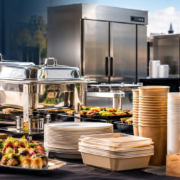
Horeca Keukenapparatuur in Amsterdam
Catering kitchen equipment for Amsterdam caterers: what you need and where to buy it
A catering job stands or falls with the organization. One missing chafing dish or a stack of glasses that is too small turns a quiet event into a race against time. That is why choosing the right catering kitchen equipment is not a last-minute task. It is the foundation of every assignment. In this guide, you will read what you need to cook, keep warm, cool, and serve. You will also learn how to produce less waste with smart disposables and glassware. De Zwijger supplies non-food products to the professional hospitality industry and delivers in Amsterdam.
What is catering kitchen equipment?
Catering kitchen equipment is everything that transports food from raw materials to the plate or buffet, outside of a fixed restaurant kitchen. Think of equipment for preparation and baking, refrigeration, transport containers, warming systems, and the tools your team works with all day long.
A restaurant kitchen stays in place. A catering kitchen travels with you. Your equipment must therefore be stackable, survive a bus ride, and be quick to clean. Weight, size, and durability weigh at least as heavily as capacity.
The basic equipment for preparing, keeping warm, and cooling
Most caterers build their setup around the same categories. Start here and add specialty items if your menu calls for it.
- Ovens and baking equipment. Finish baking dishes on-site so that the food arrives at the table fresh and hot instead of traveling fully prepared.
- Chafing dishes and warming dishes. These keep hot food at a safe temperature during long service hours.
- Gastronorm containers. The standard sizes fit most ovens, refrigerators, and transport trolleys, so that one set covers the entire chain.
- Refrigeration and freezing equipment. Cold dishes require a stable temperature from preparation to buffet.
- Knives, pans, and cutting boards. Good tools save time. Blunt knives and warped boards slow down any preparation.
- Dishwashers and dishwasher baskets. A fast throughput of plates and glasses makes a small stock function like a large one.
Temperature management deserves extra attention. Dutch hygiene guidelines for the hospitality industry generally assume that hot food is kept at 60°C or higher and cold food at 7°C or lower. [External Link: “guidelines for food temperature in the hospitality industry” -> NVWA (Netherlands Food and Consumer Product Safety Authority)] Equipment that maintains these temperatures without hassle protects your guests and your reputation.
You can view the complete range in the category [Internal Link: “catering kitchen equipment” -> De Zwijger Kitchen Equipment / Catering category page].
Why a catering wholesaler pays off for Amsterdam caterers
If you order from five suppliers, you have five invoices, five delivery times, and five chances that something gets lost. One catering wholesaler eliminates most of that hassle. You order glassware, serving items, kitchen utensils, and hygiene products in one place, with prices you see in advance.
This is how De Zwijger works. The company supplies hotels, restaurants, schools, healthcare institutions, and offices. The assortment includes glassware, tableware, kitchen utensils, cleaning products, and sustainable disposables. You order online, receive personal advice on your selection, and request a product that is not yet listed in the webshop. For events in Amsterdam, this provides you with a single point of contact for the entire supplies list.
Eco-friendly disposable tableware: where single-use still fits
Some jobs simply don’t run on porcelain. Festivals, outdoor weddings, and pop-up venues without a washing-up area require disposable plates, cups, and cutlery. In that case, eco-friendly disposable tableware is the sensible choice.
First, look at the material. Paper, wood, bamboo, and plant fibers are common alternatives to plastic. Next, check the certification mark. For compostable packaging, the European standard EN 13432 sets the requirements for industrial composting. [External Link: “standard EN 13432 for packaging” -> NEN (Royal Netherlands Standardisation Institute)]
One caveat: compostable only helps if the waste ends up in the correct waste stream. If the location does not have a green waste collection, a compostable sign simply goes with the residual waste. So, ask the location before ordering.
Sustainable hospitality disposables and the rules you need to know
The rules regarding single-use plastics have become stricter. The European directive on single-use plastics prohibits a range of plastic products, including cutlery, plates, straws, and stirrers, as well as food packaging and cups made of expanded polystyrene. [External Link: “Directive (EU) 2019/904 on single-use plastics” -> European Commission] The Netherlands has added its own requirements for takeaway to this. Therefore, check the current rules before stocking up. [External Link: “rules for single-use plastics in the hospitality industry” -> Government of the Netherlands]
This is where sustainable hospitality disposables come into play. A few rules of thumb make choosing easier:
- Check the coating. A paper cup with a plastic layer is not the same as a completely plastic-free cup.
- Choose per dish. Warm, wet, or fatty dishes call for sturdier materials than dry snacks.
- Standardize. Choose two or three sizes of trays and cups so that you can stack, store, and reorder more easily.
- Count honestly. Order for the expected number of guests plus a small margin, not an extra pallet.
The same principle applies to the rest of the buffet. Sustainable disposables work best if you choose them consciously rather than adding them to your order out of habit. De Zwijger has sustainable (CSR) disposables in its assortment and is happy to help you choose the option that suits your menu.
Sustainable glassware: reuse comes first
Disposable cups are the easiest to eliminate. A reusable glass costs more upfront, but you wash it and use it time and again. As a result, the cost per use drops rapidly. Moreover, glass can be recycled infinitely without loss of quality. [External Link: “facts about glass recycling” -> Dutch Glass Recycling Association / FEVE]
That is why sustainable glassware is worth considering at any event with a wash-up facility. A good set looks better on the table, feels more comfortable in the hand, and does justice to drinks compared to a wafer-thin cup. Guests notice that.
Take the job into account when choosing:
- Sturdy, stackable shapes survive transport and the dishwasher.
- A cohesive set of water, wine, beer, and champagne glasses keeps the table uniform.
- Printed glasses bear the logo of a venue or company, handy for business events and bars.
De Zwijger offers beer, wine, champagne, cocktail, and water glasses, plus carafes and bottles. It is also possible to print glassware with your own logo or design.
Practical checklist for catering kitchen equipment
Go through this list before confirming an event. It takes five minutes and prevents most problems.
- Count the place settings. Know how many guests are coming, how many courses there are, and whether it will be a buffet or a set table.
- Link menu to equipment. For each dish, name the pan, oven, baking dish, and serving piece that belong with it.
- Plan for keeping food hot and cold. Check if you have enough chafing dishes and cooling capacity for the entire service.
- Choose reusable or disposable. Ask if the venue can do the washing up. If not, order your disposables on time.
- Bring spares. Extra serving spoons, tongs, and lids for gastronorm containers cost little and save a lot.
- Confirm the delivery. For events in Amsterdam, agree on the date and place of delivery well in advance.
Keep a fixed list per type of event, such as a wedding, a business lunch, or a street food day. After two or three assignments, you will spend less time planning and more time cooking.
Conclusion
Strong events start with good preparation, and that begins with the right equipment. Good catering kitchen equipment keeps food at the right temperature, speeds up service, and makes every assignment repeatable. Combine that with a reliable catering wholesaler , conscious choices regarding disposables and reusable glassware where possible, and your setup becomes simpler and more environmentally friendly. De Zwijger supplies the full range, with personal advice and delivery in Amsterdam. View the assortment or send a request for anything you cannot find.
Frequently Asked Questions
1. What catering kitchen equipment does a small caterer need to get started?
Start with a reliable oven or paring unit, gastronorm containers, chafing dishes, a few good knives and cutting boards, and refrigeration. Add serving utensils and a dishwasher or dish baskets. This basic catering kitchen equipment covers most small jobs, and you expand as your menus grow.
2. How do I choose catering kitchen equipment for outdoor events in Amsterdam?
Choose materials that are lightweight, stackable, and easy to clean. Plan for keeping food hot and cold without relying on on-site power and control access for carts. Good outdoor catering kitchen equipment also requires spare tools, as you won’t easily retrieve items during the event.
3. Are sustainable disposables really better than plastic?
Often yes, but it depends on the material and waste processing. Products made from plant fibers or paper avoid prohibited plastics, and the EN 13432 mark indicates industrial compostability. They only help if the waste is collected properly, so ask the location about the waste streams in advance.
4. When should I use sustainable glassware instead of disposable cups?
Use reusable glasses as soon as you can wash them on-site or at your own location. In the long run, they cost less per use, look nicer, and generate less waste. Save disposable cups for outdoor locations or temporary spots without washing facilities.
5. Does De Zwijger deliver in Amsterdam and can I request a product that is not listed in the webshop?
Yes, De Zwijger serves caterers and hospitality businesses in Amsterdam. If a product is not listed in the webshop, please send a product request via the contact page. The team also provides personal advice on the selection of equipment and disposables for your specific situation.